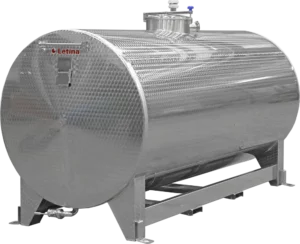
Hot Liquor Tank & Cold Liquor Tank
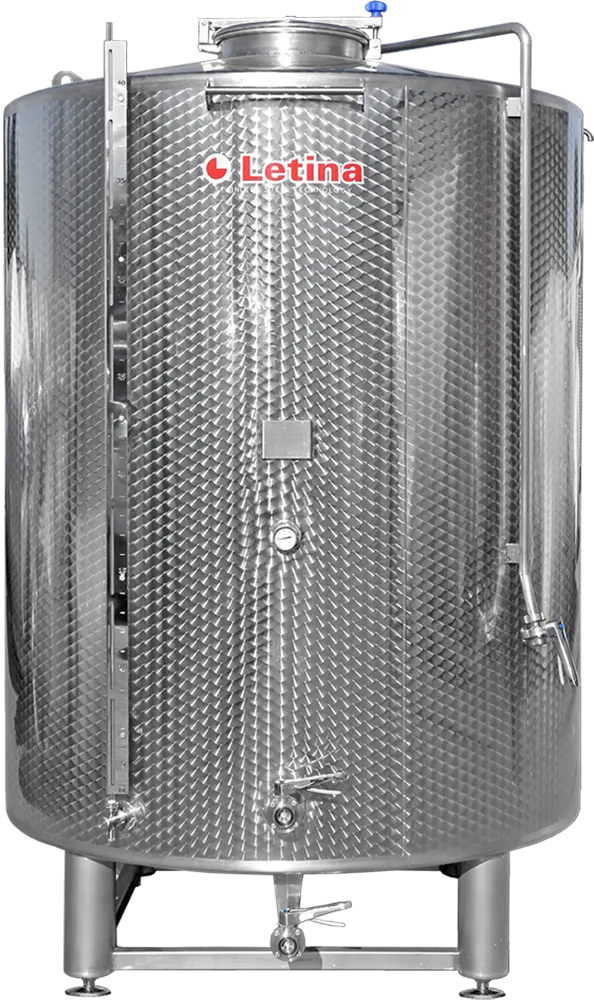
Hot Liquor Tank
The Hot Liquor Tank (HLT) is a large, insulated vessel dedicated to holding and heating water for critical stages of the brewing process. It prepares the “strike water” mixed with malt in the mash tun to convert starches into sugars, and provides the hot “sparge water” used to rinse residual sugars from the grain bed. Water in the HLT is typically heated using steam or electric immersion elements, but can also recover energy through a plate heat exchanger where hot wort transfers its temperature to incoming cold water. By allowing for precise control of water temperature and volume, the HLT is an essential anchor for brewhouse efficiency and batch consistency.
Basic Equipment
• Manhole Cover – Round Ø200 mm
• Manway Door – Oval (type CL)
• Legs – Standard (Closed)
• Cooling Jacket (0.5 m2/1000 L)
• Thermometer (analog)
• Thermowell (with PG9 fitting)
• Sample Tap (DN15)
• Partial Discharge – Ball valve (DN32 DIN)
• Total Discharge – Ball valve (DN32 DIN)
• Vent Valve – DN50 (PVC)
• Level Indicator – Ø16 mm acrylic tube (scaled, open)
• Type Plate – With note card
• Ladder rack – Coat height 1500 mm onwards
• Welding – Brushed finish
Additional Equipment
• Manhole Cover – Custom
• Manway Door – Custom
• Legs – Adjustable height and tilt
• Cooling/Heating Jacket (>0.5 m2/1000 L)
• Cooling/Heating Plate (0.4 m2/1000 L)
• Thermoregulator (digital)
• Solenoid or electromotor valve
• Ball or butterfly (Clamp, Garolla, WG, Macon, GAS, etc.)
• Stainless Steel Caps (on all valves and fittings)
• Inclined stirrer fitting
• Inert gas fitting
• Level Indicator – Ø24 mm acrylic tube (scaled, closed)
• Decanter
• Welding – Brushed and polished (Ra<0.8 µm)
• Other additional equipment available per customer request
Table of sizes
| Model | Volume | Heating system |
|---|---|---|
| HLT2000 | 2.000 lit | steam |
| HLT3000 | 3.000 lit | steam |
| HLT4000 | 4.000 lit | steam |
| HLT5000 | 5.000 lit | steam |
| HLT10000 | 10.000 lit | steam |
Other tank sizes available per client request
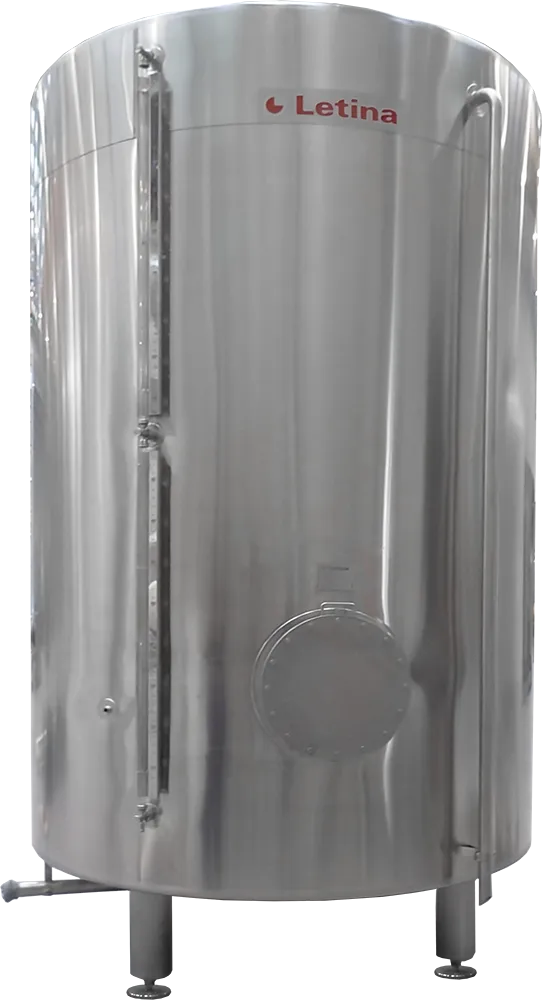
Cold Liquor Tank
The Cold Liquor Tank (CLT) is the unsung hero of temperature management and rapid wort chilling. The CLT stores process water chilled to precise, low temperatures (typically around 1°C to 7°C) using your brewery’s glycol system. Its primary and most crucial job is to “flash cool” boiling wort down to safe fermentation temperatures via a plate heat exchanger. By having a massive reservoir of cold water ready to go, the CLT ensures your cooling happens in minutes rather than hours, protecting your beer from contamination and preserving delicate hop aromatics.
Basic Equipment
• Manhole Cover – Round Ø200 mm
• Manway Door – Oval (type CL)
• Legs – Standard (Closed)
• Cooling Jacket (0.5 m2/1000 L)
• Thermometer (analog)
• Thermowell (with PG9 fitting)
• Sample Tap (DN15)
• Partial Discharge – Ball valve (DN32 DIN)
• Total Discharge – Ball valve (DN32 DIN)
• Vent Valve – DN50 (PVC)
• Level Indicator – Ø16 mm acrylic tube (scaled, open)
• Type Plate – With note card
• Ladder rack – Coat height 1500 mm onwards
• Welding – Brushed finish
Additional Equipment
• Manhole Cover – Custom
• Manway Door – Custom
• Legs – Adjustable height and tilt
• Cooling/Heating Jacket (>0.5 m2/1000 L)
• Cooling/Heating Plate (0.4 m2/1000 L)
• Thermoregulator (digital)
• Solenoid or electromotor valve
• Ball or butterfly (Clamp, Garolla, WG, Macon, GAS, etc.)
• Stainless Steel Caps (on all valves and fittings)
• Inclined stirrer fitting
• Inert gas fitting
• Level Indicator – Ø24 mm acrylic tube (scaled, closed)
• Decanter
• Welding – Brushed and polished (Ra<0.8 µm)
• Other additional equipment available per customer request
Table of sizes
| Model | Volume |
|---|---|
| CLT1000 | 1.000 lit |
| CLT2000 | 2.000 lit |
| CLT3000 | 3.000 lit |
| CLT5000 | 5.000 lit |
| CLT10000 | 10.000 lit |
Other tank sizes available per client request
Can't Find the Ideal Tank?
Talk to one of our engineers and describe your requirements. We will design a unique solution perfect for your processing needs.
Frequently Asked Questions
What exactly is "Liquor" in the brewing process?
In a professional brewhouse, the word “liquor” has nothing to do with distilled spirits—it is simply the traditional term for the processed water used to make beer. Because water makes up over 90% of the final product, its chemistry is heavily manipulated. Brewers treat raw water to adjust mineral content, hardness, and pH levels to suit specific beer styles. To keep recipe formulations clear on the brew deck, cold processed water is called Cold Liquor, and heated water is called Hot Liquor.
How are the CLT and HLT integrated into a professional brewing system?
They function as a synchronized, closed-loop thermal recovery system.
Wort Cooling: After the boil, cold water from the CLT is pumped through a plate heat exchanger to rapidly cool the boiling wort down to safe fermentation temperatures.
Heat Recovery: As that cold water cools the beer, it absorbs massive amounts of heat. Instead of dumping it down the drain, this newly heated water is directed straight into the HLT. This pre-heated water is then instantly ready for your next mashing cycle or for cleaning, drastically cutting down your energy bills and water waste.
How should a brewery calculate the proper sizing for their HLT and CLT?
Proper sizing is critical to avoid production delays and save energy. Sizing depends heavily on your daily brewing frequency and batch sizes.
HLT Sizing: Your Hot Liquor Tank must hold enough water for mashing, sparging the grain bed, and cleaning the system. The industry standard is to size the HLT at 1.5 to 2 times the volume of your brew kettle.
CLT Sizing: To pull off back-to-back brews without waiting for a glycol chiller to slowly recover, you need a massive buffer of ice-cold water. A production-ready CLT should be sized at 2 to 3 times your batch size.
Do I need automated controls for these tanks?
While manual systems work for small startups, production breweries rely on automation to maximize efficiency and minimize labor. With Letina INTECH, linking your HLT and CLT to automated temperature sensors and flow meters ensures that water is redirected perfectly during the heat-exchange process without constant manual monitoring.
What does Letina INTECH offer for HLT and CLT water preparation?
Our automation features a centralized display of key process values and equipment statuses. It offers precise temperature regulation via On/Off or PID Ramp control. Crucially for water management, it handles automatic inlet/outlet measurements linked directly to your water preparation schedules, ensuring you always have exactly the right amount of hot or cold liquor when you need it.
Related products
Related products
[KR] Square Tank
Engineered to maximize cellar footprint, providing high-volume storage in a space-saving, rectangular design.
[PZP] Variable Capacity Tank
Provides total flexibility for varying harvest volumes by using a moveable lid to eliminate headspace and oxidation.
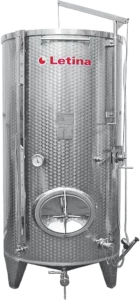
[T] Pressure Tank
Specifically reinforced to handle internal pressure requirements for carbonation or pressurized liquid transfer.
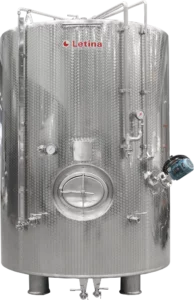
[ZL] Horizontal Storage Tank
Ideal for facilities with low ceilings, offering stable temperature control and high-capacity storage.