Certificates

ISO 9001
Quality management system

PED 2014/ 68/EU
Pressure Equipment Directive
EN ISO 3834-2
Quality requirements for fusion welding of metallic materials

ASME U
Boiler and Pressure Vessel Code

VLAREM II
Flemish Regulations on Environmental Permitting

GMP
Compliance for stainless steel surfaces in contact with food

At Letina, we are dedicated to delivering quality without compromise. By consistently exceeding industry standards, we ensure reliable, safe, and high‑performance products.
Our manufacturing processes are guided by strict quality controls and continuous improvement, enabling us to meet demanding technical and regulatory requirements. This approach allows us to provide durable, precision‑engineered solutions our customers can rely on.
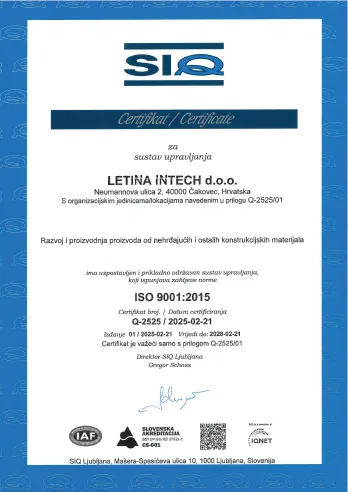
ISO 9001:2015
Quality Management Systems – Requirements
ISO (the International Organization for Standardization) is a worldwide federation composed of representatives from various national, standard-setting organizations. Since 1947, the organization promotes worldwide proprietary, industrial, and commercial standards. It is headquartered in Geneva, Switzerland, and works in 164 countries.
ISO 9001 defines the criteria for a quality management system (QMS) and is based on a set of quality management principles, including a strong customer focus, process approach, and continual improvement. It applies to organizations of all sizes and industries, ensuring consistent quality in products and services.
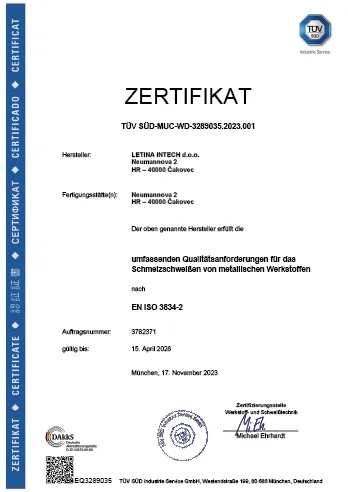
EN 3834-2
Quality requirements for fusion welding of metallic materials
ISO (the International Organization for Standardization) is a worldwide federation composed of representatives from various national, standard-setting organizations. Since 1947, the organization promotes worldwide proprietary, industrial, and commercial standards. It is headquartered in Geneva, Switzerland, and works in 164 countries.
EN 3834-2 defines standard quality requirements for fusion welding of metallic materials both in workshops and at field installation sites.
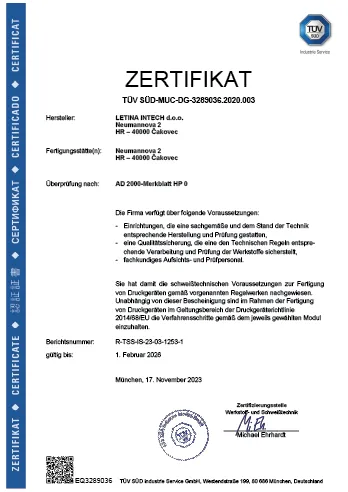
PED 2014/68/EU
Pressure Equipment Directive
The Pressure Equipment Directive (PED) applies to the design, manufacture and conformity assessment of pressure equipment and assemblies with a maximum allowable pressure greater than 0.5 bar gauge including vessels, piping, safety accessories and pressure accessories.
The PED provides a legal structure whereby pressure equipment can be manufactured and sold throughout the European Union without having to go through a local approval regime in every member state.
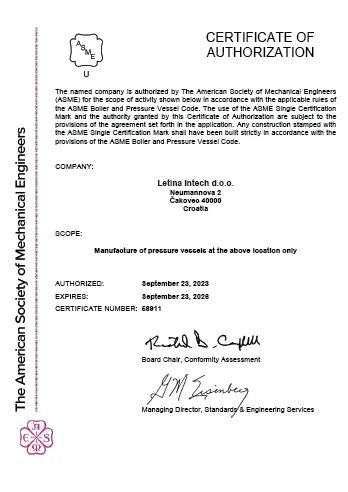
ASME U
Boiler and Pressure Vessel Code
ASME stands for “American Society of Mechanical Engineers”, a non-profit organization with the goal of “helping the global engineering community develop solutions to benefit lives and livelihoods”. ASME is one of the leading international standards and code developers for the mechanical engineering industry
The ASME Boiler and Pressure Vessel Code (BPVC) is a universally-acknowledged set of standards developed by the American Society of Mechanical Engineers. It regulates the design, manufacture, installation, inspection and care of boilers, nuclear components, and other pressure vessels.
VLAREM II
Flemish Regulations on Environmental Permitting
VLAREM stands for “Vlaams Reglement betreffende de Milieuvergunning” (“Flemish Regulations on Environmental Permitting”).
It is a set of standards that aim to prevent environmental pollution and manage safety hazards of businesses. It targets activities considered harmful to the environment – such as waste storage, the production of chemicals, noise pollution, combustion processes, etc.
VLAREM II contains, among other things, general terms and conditions for private companies regarding the storage of dangerous substances in tanks.
GMP
Good Manufacturing Practice Compliant - Surfaces that come into contact with food
1. Technical Consultation & RFQ
Initial review of customer specifications, CAD drawings, and process requirements. Focus : Feasibility analysis and preliminary material selection (AISI 304/316L).
2. Engineering & DFM
Technical optimization of the design to ensure structural integrity and cost-efficiency. Focus : Finalizing static calculations, pressure ratings (PED/ASME), and component detailing.
3. Precision Fabrication
Production begins in our ISO-certified facility using laser cutting, rolling, and CNC machining. Focus : Strict adherence to tolerances and high-quality welding standards.
4. Quality Control & Certification
Rigorous testing phase including pressure tests, X-ray weld inspection, and surface RA measurement. Focus : Final documentation, material certificates (3.1), and quality approval.
5. Strategic Logistics
Preparation for global transit, including sectional packing for oversized vessels. Focus :Export-grade bracing and coordination of specialized transport (Land/Sea).
6. Installation & Commissioning
On-site assembly of segmented units and integration of supporting structures. Focus : Final inspection and handover of the operational system.