
Grape Juice Separation Tank
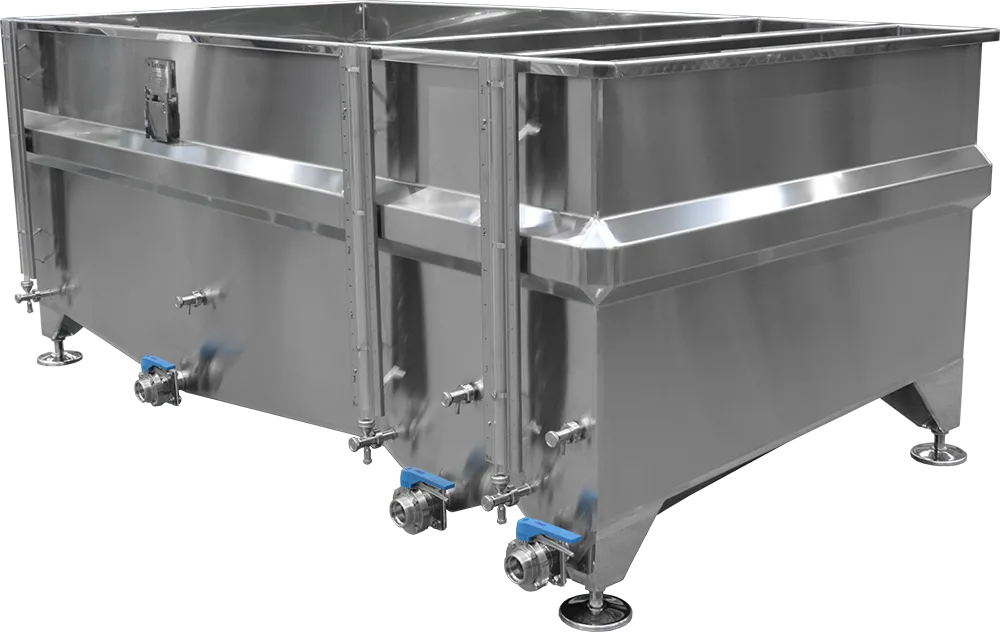
Grape Juice Separation Tank
The Grape Juice Separation Basin is an open-top, multi-chambered stainless steel vessel designed for high-efficiency fractional juice collection. Specifically engineered to fit beneath a grape press, this basin allows for the immediate segregation of juice as it is extracted, preventing the mixing of high-acid free-run juice with more phenolic later pressings.
Featuring a robust, low-profile design and reinforced stainless steel construction, the basin is divided into three distinct, independent sections. This enables winemakers to grade their juice in real-time adn optimize the quality of the must for premium wine production, sparkling base wines, or distillation.
Open-Top Design: Low-clearance construction allows for direct placement under the press for effortless gravity-fed collection.
Three Independent Fractions: Segregate juice into three quality grades—First Press (Premium), Second Press (Fruity/Finesse), and Third Press (Distillation/Standard).
High-Flow Discharge Valves: Each compartment is equipped with its own large-bore butterfly valve and sampling port for rapid transfer to fermentation tanks.
Visual Volume Indicators: Integrated external level gauges on each compartment allow for precise monitoring of yield during the pressing cycle.
Tank Options
- Wheels
- Stand for Forklift Transport
- PU Foam Insulation
- Green Line Stainless Steel
- Stackable
Basic Equipment
• Manhole Cover – Round Ø200 mm
• Manway Door – Oval (type CL)
• Legs – Standard (Closed)
• Cooling Jacket (0.5 m2/1000 L)
• Thermometer (analog)
• Thermowell (with PG9 fitting)
• Sample Tap (DN15)
• Partial Discharge – Ball valve (DN32 DIN)
• Total Discharge – Ball valve (DN32 DIN)
• Vent Valve – DN50 (PVC)
• Level Indicator – Ø16 mm acrylic tube (scaled, open)
• Type Plate – With note card
• Ladder rack – Coat height 1500 mm onwards
• Welding – Brushed finish
Additional Equipment
• Manhole Cover – Custom
• Manway Door – Custom
• Legs – Adjustable height and tilt
• Cooling/Heating Jacket (>0.5 m2/1000 L)
• Cooling/Heating Plate (0.4 m2/1000 L)
• Thermoregulator (digital)
• Solenoid or electromotor valve
• Ball or butterfly (Clamp, Garolla, WG, Macon, GAS, etc.)
• Stainless Steel Caps (on all valves and fittings)
• Inclined stirrer fitting
• Inert gas fitting
• Level Indicator – Ø24 mm acrylic tube (scaled, closed)
• Decanter
• Welding – Brushed and polished (Ra<0.8 µm)
• Other additional equipment available per customer request
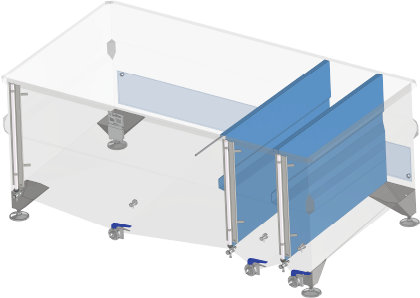
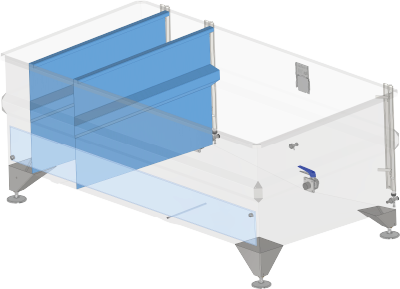
3D
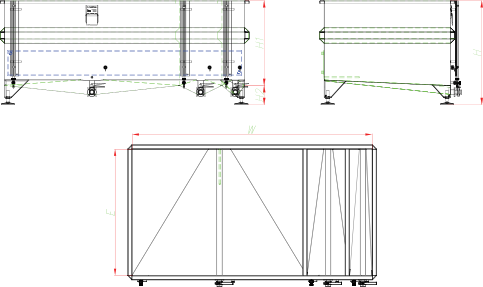
| Type | (W) width | (L) length | Height |
|---|---|---|---|
| KS2500-600-300S28-15 | 2.760 | 1.500 | 940 |
| KS2500-600-300S27-13 | 2.650 | 1.270 | 1.155 |
| KS4500-1000-500S39-15 | 3.900 | 1.450 | 1.155 |
| KS600-300-2500S46-9 | 4.550 | 840 | 1.000 |
| KS2500-600-300S28-15 | 2.780 | 1.500 | 930 |
| KS4500-1100-400S48-15 | 4.810 | 1.500 | 930 |
| KS2500-600-300S29-15 | 2.870 | 1.500 | 1.080 |
| KS1500-1000-600-300S29-15 | 2.850 | 1.500 | 900 |
| KS1200-360-300S22-18 | 2.200 | 1.750 | 600 |
| KS3500-800-400S35-17 | 3.384 | 1.650 | 950 |
Other tank sizes available per client request
Can't Find the Ideal Tank?
Talk to one of our engineers and describe your requirements. We will design a unique solution perfect for your processing needs.
Frequently Asked Questions
Why is it important to separate grape juice into three compartments?
Not all juice from a single press cycle is equal. The first press is usually the highest quality (free-run). The later presses extract more potassium and tannins from the skins, which changes the pH and flavor. Using a multi-compartment separation tank allows you to “grade” your juice in real-time, ensuring your top-tier wine isn’t diluted by lower-quality fractions.
How do the external level gauges help during the press cycle?
These gauges allow the operator to see exactly how much juice has been collected in each compartment at a glance. This is vital for fractional pressing, as it helps the winemaker decide exactly when to divert the flow from the first quality grade to the second.
Can the compartments be cleaned individually?
Yes. Each compartment is a fully isolated unit with its own dedicated drainage and discharge valves. This means you can begin pumping out the premium first-press juice while the press is still filling the second or third compartments, maximizing your cellar’s throughput.
Is this basin suitable for whole-cluster pressing?
Absolutely. Because there are no internal obstructions or narrow inlets, it easily handles the juice flow from whole-cluster pressing, which can often contain higher amounts of solids and stems that might clog standard tank inlets.