
Horizontal Serving Tank
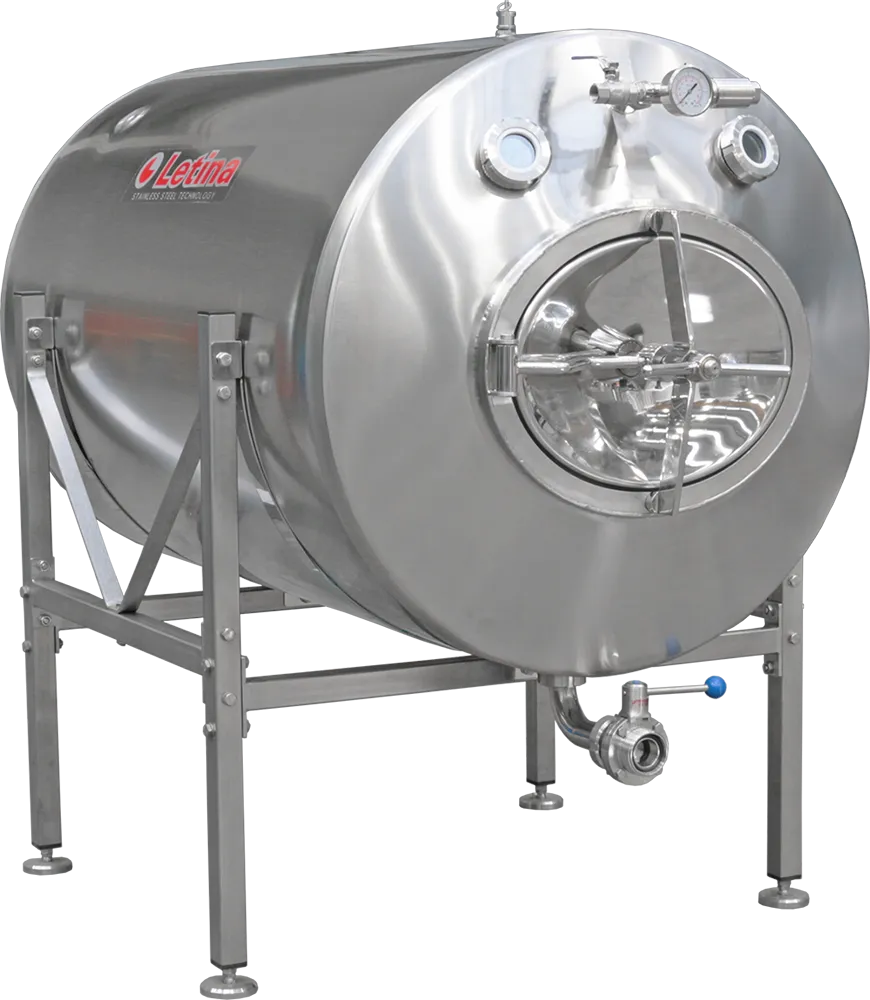
Horizontal Serving Tank
Bag-In-Tank serving tanks represent a groundbreaking shift in draft beer distribution and taproom efficiency. Designed to deliver brewery-fresh beer directly to the glass, this technology utilizes an internal, recyclable plastic bag (liner) to house the beverage. By using clean compressed air pumped between the tank wall and the bag, the beer is pushed to the taps without ever coming into contact with outside air, oxygen, or added push-gases.
This advanced “cellar-to-glass” system completely eliminates the need for expensive, space-hogging cold rooms and heavy keg rotations. Because the tank is independently chilled and requires no chemical cleaning between batches—simply swap the bag—you drastically cut your water, chemical, and energy expenses. It is the ultimate space-saving, high-profit solution for modern taprooms, high-volume bars, and event venues.
Zero CO2 or Mixed Gas Needed: The system uses standard compressed air against the outside of the bag to propel the beer, saving thousands on gas cylinders.
Cold Room Elimination: Free up square footage in your venue. These insulated, independently cooled tanks eliminate the need for a massive, energy-draining walk-in cooler.
No Kegs, No Chemicals: Forget the labor-intensive cycle of hauling, washing, and filling kegs. The single-use sterile liner means zero tank washing and zero chemical costs.
Extended Shelf Life: Because the beer is perfectly isolated from light and gas, it prevents over-carbonation and oxidation, maintaining brewery-fresh flavor for up to 12 weeks.
Maximized Yield & Profit: Experience near-zero product loss. The pressure on the bag ensures smooth dispensing down to the very last pint with no “foaming” or bottom-of-the-keg waste.
Tank Options
- Wheels
- Stand for Forklift Transport
- PU Foam Insulation
- Green Line Stainless Steel
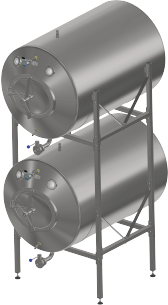
- Stackable
Basic Equipment
• Manhole Cover – Round Ø200 mm
• Manway Door – Oval (type CL)
• Legs – Standard (Closed)
• Cooling Jacket (0.5 m2/1000 L)
• Thermometer (analog)
• Thermowell (with PG9 fitting)
• Sample Tap (DN15)
• Partial Discharge – Ball valve (DN32 DIN)
• Total Discharge – Ball valve (DN32 DIN)
• Vent Valve – DN50 (PVC)
• Level Indicator – Ø16 mm acrylic tube (scaled, open)
• Type Plate – With note card
• Ladder rack – Coat height 1500 mm onwards
• Welding – Brushed finish
Additional Equipment
• Manhole Cover – Custom
• Manway Door – Custom
• Legs – Adjustable height and tilt
• Cooling/Heating Jacket (>0.5 m2/1000 L)
• Cooling/Heating Plate (0.4 m2/1000 L)
• Thermoregulator (digital)
• Solenoid or electromotor valve
• Ball or butterfly (Clamp, Garolla, WG, Macon, GAS, etc.)
• Stainless Steel Caps (on all valves and fittings)
• Inclined stirrer fitting
• Inert gas fitting
• Level Indicator – Ø24 mm acrylic tube (scaled, closed)
• Decanter
• Welding – Brushed and polished (Ra<0.8 µm)
• Other additional equipment available per customer request
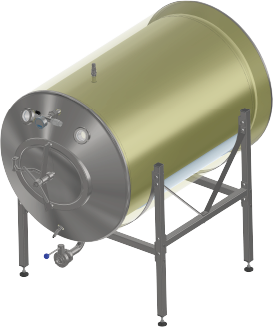
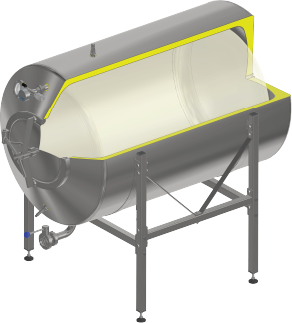
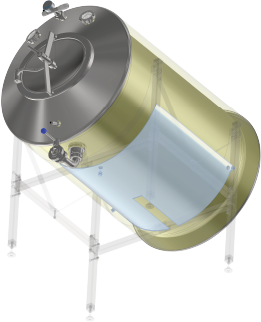
3D
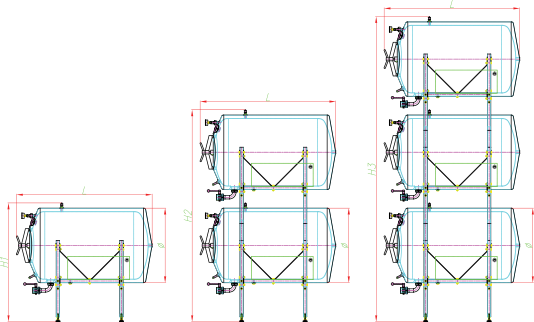
| Type | Volume | Ø (mm) | L (mm) | H1 (mm) | H2 (mm) | H3 (mm) |
|---|---|---|---|---|---|---|
| ZBS250A7 | 250 lit | 730 | 1.240 | 1.250 | 2.275 | 3.300 |
| ZBS500A8 | 500 lit | 880 | 1.600 | 1.400 | 2.500 | 3.600 |
| ZBS1000A8 | 1.000 lit | 2.560 | 1.400 | 2.500 | 3.600 |
Other tank sizes available per client request
Can't Find the Ideal Tank?
Talk to one of our engineers and describe your requirements. We will design a unique solution perfect for your processing needs.
Frequently Asked Questions
How exactly does a Bag-In-Tank system work?
It is a brilliantly simple concept. A sterile, food-grade plastic bag (liner) is placed inside the pressure tank and filled with fresh beer. To serve, a standard air compressor pumps air into the space between the inner tank wall and the outer surface of the bag. This air pressure gently squeezes the bag, pushing the beer out to the draft tower. Because the air never touches the beer, the product remains perfectly sterile.
Why does the beer stay fresh longer than in a keg?
In a traditional keg system, as the keg empties, CO2 or mixed gas fills the headspace to push the beer out. Over time, this extra gas dissolves into the beer, causing over-carbonation, off-flavors, or a “spluttering” tap. With Bag-In-Tank technology, the beer stays completely sealed in an anaerobic (oxygen-free) environment with no added gas. This preserves the brewer’s intended flavor profile and extends the tap shelf life up to 12 weeks—making it perfect for slower-moving craft specialties.
How do the stackable frames benefit my venue's layout?
Floor space is a premium asset in any bar or taproom. Our serving tanks are designed with robust, reinforced framing that allows them to be safely stacked on top of one another. Instead of spreading kegs across a massive floor area, you can build a vertical “wall of beer.” This not only looks highly industrial and attractive to customers but can easily triple your volume capacity in the exact same footprint.
Is it true that I don't have to clean the tanks with chemicals?
Yes! This is one of the biggest labor-saving features. Because the beer only ever touches the inside of the sterile bag, the stainless steel tank itself never gets dirty or develops “beer stone.” When a tank runs empty, you simply open the manway, remove the spent bag, throw it in the recycling, and insert a fresh one.
How does this system reduce product loss?
Ask any bartender and they will tell you that the first and last few pints of every keg are usually wasted as foam. Because the pressure in a Bag-In-Tank system is applied evenly and consistently across the entire surface of the bag, the flow rate remains perfectly steady. You get clear, perfectly carbonated pours from the first glass to the absolute last drop.